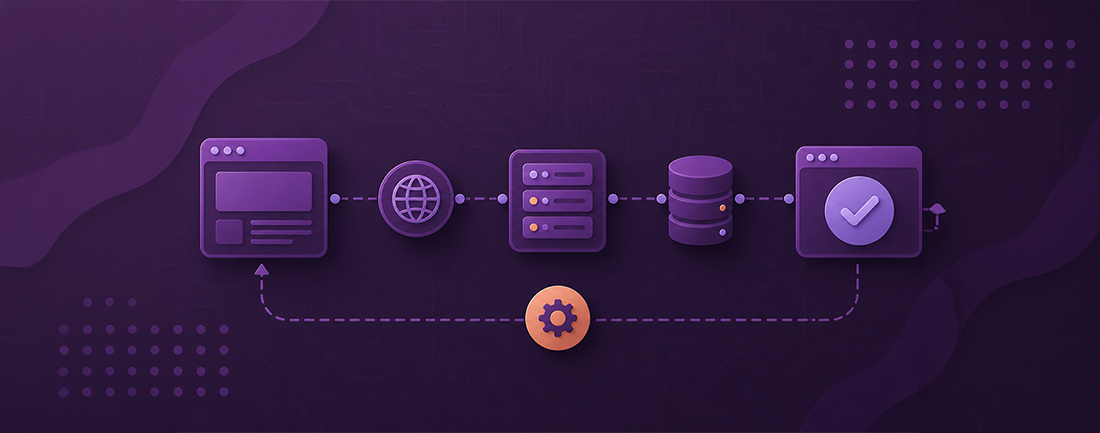
What is End-to-End Testing?
End-to-end testing is a software testing methodology, as the name itself says it is end-to-end flow testing, where the test engineer tests the functionalities and performance of an entire software application flow from start to end or navigates through all the features/modules and checks whether end feature or last feature is working as expected or not.
It is also defined as “System Integration Testing” which is a level of testing that validates the complete and fully integrated software. System Integration Testing aims to evaluate the end-to-end system specification, simulate real user scenario, and validate the system under test and its components for integration and data integrity. This is also called Business Workflow Testing where the entire workflow is validated Ex: The payments workflow can get triggered from a mobile and can go on till the amount is credited/debited and reporting is completed.
for end-to-end user scenarios like application communication with hardware, database, network, and other applications.
The main thing to carry out this testing is to ascertain various dependencies of an application as well as ensure that accurate information is communicated between various system components. It is usually performed after any application's functional and system testing.
For example: Verify that the user can purchase the products from an online shopping portal.
-
Open the browser, Enter the URL
-
Create an account
-
Login
-
Search the product
-
Add the product to the cart
-
Go to cart
-
Click on the buy product button
-
Add the address
-
Payment mode
-
Proceed for payment
-
Place the order
-
Verify the placed order message
-
Logout
Problems of not doing End-to-End testing:
End-to-end tests generally take more time to execute because of their nature. Therefore, they are more expensive and require an infrastructure of their own. It requires in most cases dependencies which could cause more problems of their own.
Complexity: E2E testing can be complex and time-consuming, especially for large and complex applications.
Slow Execution: E2E tests can take a long time to execute, especially for applications with extensive workflows, which can slow down the development process.
Debugging Challenges: Finding and debugging the problems in E2E testing can be challenging, as the cause of the problems may be located in any feature of the application or its dependencies.
Maintenance Overhead: E2E testing requires proper maintenance to keep them up to date with changes in the software, which can be time-consuming. False Positives: E2E testing sometimes may produce false positives, which indicates problems that are not present in the software.
Benefits of End-to-End Testing:
The E2E testing process has allowed for expanded test coverage during software testing.
Improves Application Quality: By testing the entire application E2E helps identify the issues that may not be evident in unit testing or Integration testing. By performing this type of testing you will be able to identify the issues and defects before they affect users, improving the quality of your application and reducing the time.
Increased Confidence: E2E testing helps to increase the confidence of the application while automating the process of software testing to a great level. This means your teams can process massive amounts of data, code, and interfaces quicker and more accurately. It also frees up your team time to focus on other critical tasks, like adding features to the application or fixing issues that require manual attention. With automated end-to-end testing, your team can be more productive and achieve better quality products.
Enables Early Detection and Debugging: E2E testing helps that all the features of an application work together smoothly. Since we are testing the application, it means we can identify and rectify or debug the issues earlier in the development cycle, and also helps to build a product that is more stable and trustworthy.
Reduces Costs: Testing the application from start to end may seem like a prolonged and wasted testing activity. In reality, it saves time and money that would have been spent on fixing the bugs by end-users. E2E testing may seem costly, but in the long run, it will help to reduce maintenance costs and improve user satisfaction by catching issues before they can cause problems.
Enhances Customer Satisfaction: The main goal of testing is to ensure customer satisfaction. E2E testing helps businesses provide a more comprehensive and consistent user experience to their customers. By identifying and preventing issues before they can cause a problem for end-users, E2E testing also helps to ensure that your customers receive the best experience possible and it leads to improved customer satisfaction and retention rates.
Challenges & Pain Points of End-to-End Testing:
End-to-end workflow knowledge: Automated end-to-end tests are essential for ensuring high-quality applications. We need to understand the product very well to create test cases.
Flakiness in the test: It is a common issue that E2E testing has a negative image for producing inconsistent, unreliable results. It’s a huge pain when your test suite runs seamlessly one day, only to have a test fail for no apparent reason.
Maintenance: E2E tests can be fragile and require frequent updates and maintenance as the application changes and end-to-end testing can be difficult to maintain, especially if the software application changes frequently by using Excel or XML for different product combinations like product ID, Price, Quantity, Payment, etc.
Environment Setup: Setting up the test environment to emulate the production environment accurately can be challenging, leading to inconsistencies and issues in testing.
Security and Performance: Applications must provide easy and fast access to certain data for the user while preventing malicious and unauthorized user access to the system. The testing of access points should be included in Security testing, Performance testing, Functional testing, and Usability testing as well.
Data validation: To verify web applications dealing with sensitive data, it is highly recommended to utilize a test automation tool that verifies access points before they are put into production.
FireFlink Solutions: Flakiness in the test:
-
To overcome test flakiness, FireFlink provides the Analytics feature where we can analyze flaky scripts so that our maintenance becomes very easy.
-
What is flaky?
The behavioral changes of test cases sometimes during some integrations or any test cases added to the suite, test cases that previously passed may fail due to changes in the test cases suite. So in the same fashion if we didn’t have this feature like “flaky”, we would have taken more time to analyze which test case failed. So to overcome that in the FireFlink platform, we have a separate section called analytics. In analytics, we have flaky which shows the behavior of test cases and also the current situation of the test cases.
-
The FireFlink Finder tool will identify the most optimal locators for the single element. So that whenever the application UI is reskinned it avoids the script failure because of the locator reason even FireFlink supports auto prioritization of the locators which helps us to reduce the execution time.
-
In FireFlink Data-driven testing is very easy. Data-driven testing in traditional automation your end-to-end testing is very difficult because we write the data from multiple different types of files like XML files, PDF files, etc. In contrast, the solution in FireFlink is we have already handled all the types of files in FireFlink without coding, users can read data from the files.
-
We do support multiple layers of testing. We can test the Business layer, Database layer, and Presentation layer. So, developing End-to-End scripts is very easy in FireFlink. Single Thread Multi-channel execution: We can execute all types of applications in the same script we can include both web, web services, and mobile. For example, if the user wants to register for a web application where the OTP will be shared with the mobile. The same OTP has to be entered into the web application to proceed. Whereas sometimes we have to get the details through the APIs.
Conclusion:
For any commercial release of the software, End-to-End Testing plays an important role.
It tests the entire application in an environment that exactly imitates real-world users like network communication, database interaction, etc.
end-to-end (E2E) testing is a vital part of the Software Testing Life Cycle (STLC) , ensuring that your application functions correctly from end to end. It involves testing the entire application workflow, including user interactions, integrations, and dependencies, to verify that all components work together as expected.
Keeping all this in mind to reduce your testing time and also to make it a more accurate and productive time,FireFlink is a suitable platform for automating end-to-end testing efficiently.